Employees Built with AI
Two ways in.
Start where you are.
If you're new to building with AI, start small and prove it works. If you already want the whole system, come straight to the cohort. Same destination either way.

Hire Week
One week, three short build sessions, and you build your first AI employee. It opens with a free workshop, and what you pay credits toward the cohort.
See Hire Week →The Cohort
AI employees across every part of the business, running on a Business Brain, with a group of operators building alongside you. The full team, not one employee.
See what's included →Hire Week is the on-ramp, and what you pay there comes off the cohort.
Three things you walk out
with. For good.
It all runs on one question: would I hand this to a new hire? The work you'd say yes to is the work that becomes an AI employee. Over the cohort you'll learn to spot it, build the employees that handle it, and organize your business so AI can run on it. One piece at a time.
AI employees that know your business.
Trained on your voice, your data, your process. Like onboarding a smart new teammate, except it shows up the same day and works on a schedule while you sleep.
Every part of the business.
Marketing, sales, operations, customer success, people, and finance. You ask the same question in each one, would I hand this to a new hire? Then you build an AI employee for every yes, one by one, until the repetitive work across the business has somewhere to go that isn't you.
A Business Brain underneath it all.
Your knowledge, SOPs, client stories, and numbers, organized so AI can use them. The real moat right now is you knowing what you know. This is where it lives.
- Weekly live builds
- Weekly office hours
- A community of operators building the same thing
- Recordings for a full year
What operators built.






You're already using AI.
You just haven't built with it yet.
Most operators aren't behind the way they think. The gap isn't whether you use AI. It's whether you've built anything with it that's still working tomorrow morning.
One answer at a time.
You open Claude or ChatGPT, ask a question, get a decent answer, close the tab. Tomorrow you start over and re-explain everything. Nothing's saved, nothing's trained, nothing's connected. You're treating AI like a search engine when it's a new hire you haven't onboarded. And when you hit a ceiling, you do what you've always done: you hire another person.
It can do the work now.
A while back, AI could write and answer. That was about it. Now it reads your spreadsheets, connects to your tools, runs on a schedule, and handles multi-step work without you sitting there. The pieces to build an AI employee that does real work didn't exist a year ago. They do now, and none of it needs code.
A leaner way to run.
The leanest operators are running on a small team plus a stack of AI employees that handle the repeatable work. The point isn't doing more. It's closing the laptop at a normal hour because the business runs on systems, not on your energy.
Four pieces.
One system.
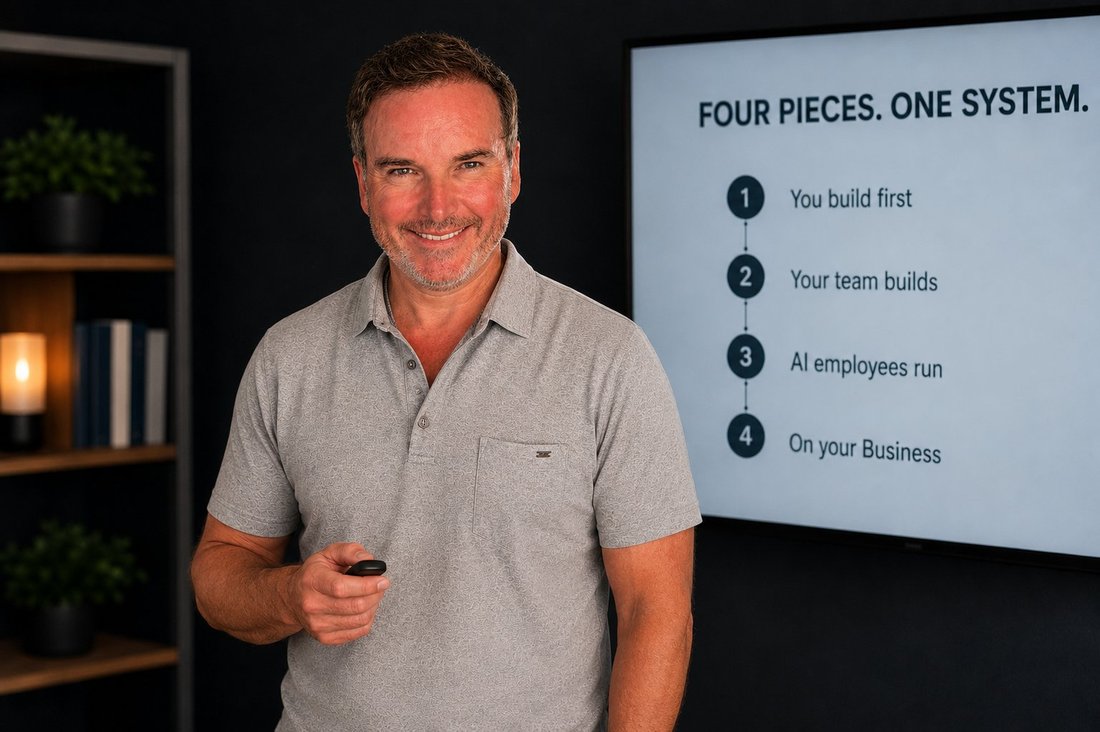
An AI-powered business isn't one tool. It's four pieces stacked in order. The work you do in the cohort builds all four.
You, building first.
If you won't build, your team won't either. You don't have to be technical. You have to be the one who goes first.
Your team, building too.
Anyone who can train a new hire can build an AI employee. Your people go from doing the work to building the thing that does the work.
AI employees, running.
Trained helpers that do a specific job, on demand or on a schedule. They know your business because you trained them.
The Business Brain.
Your knowledge, organized so AI can use it. Without it, every AI employee you build starts from zero every time.
What you build,
week by week.
Every week, you build something real and it's working in your business before the next one. The blank chat box gets everyone. So we don't leave you staring at it.
Mindset, Skills & Your Business Brain
Think like an operator, write reusable Skills, connect your tools, and build the Business Brain every agent draws from.
Marketing Automated
Trend spotter, content writer and atomizer, lead-magnet and case-study builder.
Leads to Sales Growth
Lead extractor with outreach, ad optimizer, and a sales-call coach.
Ease the Day to Day
SOP creator, transcript-to-project-plan, and a market-expansion scoper.
Keep Them Coming Back
Testimonial catcher, sentiment radar, and a win-back agent.
Hire Right, Lead Better
Interview and onboard kit, growth coach, and a tough-conversations planner.
Know Your Numbers
Plain-English reporting, cash-flow goals, and a cost-reduction agent.
Staying in the Top 1%
The tools keep changing. You leave with a personal roadmap and a simple system for staying ahead, so you finish as a builder who knows how to keep going, not someone who just took a course.
Chief of Staff & Board of Advisors
A personal Chief of Staff plus an on-call advisory panel.
Get Found in AI Search
See if AI recommends you, then build the content that gets you cited.
Visuals Without a Designer
A designed landing page plus product shots, graphics, thumbnails, and short video.
That's the full roster. Eight weeks, three bonus builds, every employee yours to keep.
See pricing →From people who
aren’t techies.



Before your next hire,
read this.
You got the business this far by being good at almost everything. That's exactly why everything runs through you now. And the usual fix is the same one it's always been: hire another person, add overhead, add management. I spent years as a CFO approving hires like that, and the salary is the smallest part of the cost. There's another option worth looking at first.
- ✗ Salary, benefits, taxes
- ✗ Months to hire and onboard
- ✗ PTO, sick days, turnover
- ✗ More to manage, not less
- ✓ Trained on your business and your voice
- ✓ Built and running the same week
- ✓ Works on a schedule, doesn't quit
- ✓ Does the work that was below your time anyway
And the hire you were about to make already has a shape. The marketing coordinator becomes a content writer that posts in your voice. The sales assistant becomes a lead-and-outreach employee that keeps the follow-up moving. The admin becomes an SOP builder that documents the work once. You build the role instead of filling it, and it starts the same week.
The money matters. But the real reason to do this is the day you get back. Right now your day fills up with follow-ups, updates, reports, and chasing, and the work that grows the business waits until you've got nothing left. When the repetitive work has somewhere else to go, you get the morning back. That's the whole trade.
This isn't about
replacing your people.
AI employees don't replace your team. They replace the work your team shouldn't have been doing in the first place. The relationships, the judgment calls, the creative leaps, the leadership, that's all still human, and it always will be.
We love AI. But we love humans more. The most valuable person in a business is no longer the one who can do the most work. It's the one who can build the AI employees that do the work. Give every person on your team a few AI employees to work beside them, and you're not replacing anyone. You're freeing them up to do the work that actually matters.
Chris Jarski, founder of Employees Built with AI
What's probably
stopping you.
Most of these are partly true. All of them are workable. Here's how I think about each one.
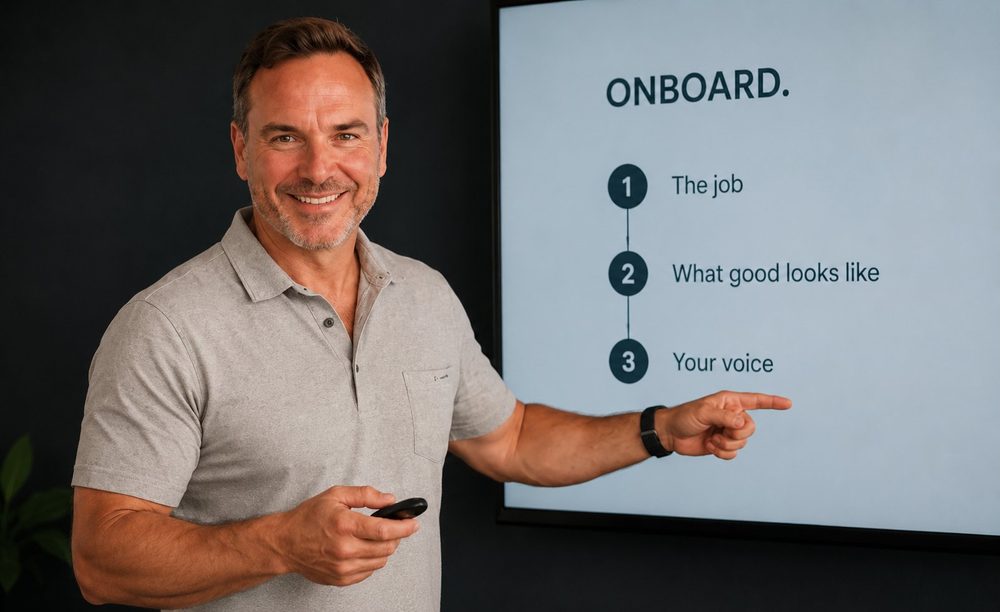
This is the most common one and it's the most wrong. Building an AI employee is a communication skill, not a coding skill. If you can explain your business to a new hire, you can do this. You're not writing code. You're onboarding a teammate. If you want the gentlest start, build one in Hire Week first.
With Hire Week. It's the one-week on-ramp: a free workshop plus three short build sessions where you build your first AI employee. If the full cohort feels like a lot right now, start there, prove it works, and what you pay comes off your cohort price. See Hire Week →
You're right, most of it is. That's what happens with no system behind it. The AI doesn't know your business, your voice, or your standards, so it guesses. Trained on your data, it sounds like you, because it's running on you.
That's not on your team. They got a powerful tool with no training and no guardrails. That's like hiring someone and skipping onboarding. Here, every person builds one purpose-built employee for their actual role. The tinkering stops because the thing works.
It's the opposite. Big companies can afford to be inefficient. You can't. Every hour matters more when you're small, and you can roll this across the whole business in weeks instead of waiting on anyone's approval.
AI doesn't care about your industry. It cares about your workflow. HVAC, landscaping, a med spa, a bookkeeping practice, a fashion brand, it's all marketing, sales, ops, and finance underneath. The data changes. The build doesn't.
You're spending real hours every week on repetitive work right now. This replaces that work, it doesn't add to it. Most people get time back in the first couple of weeks, not at the end. You don't have time not to.
Most courses show you what's possible and leave you to figure out how to apply it. You leave inspired and nothing changes. Here you build something real every week, and two full weeks are set aside just to install what you built and fix what isn't firing yet, in your real workflow. You don't leave with a folder of ideas. You leave with employees that are running. Not theory. Built.
The tools will keep changing. That's the point of the last week. It's not another tool, it's a simple system for telling a real upgrade from noise, so you keep up on your own after the cohort instead of falling behind again. You leave able to adapt, not just caught up for now.
If you've got the free weekends to test and build and start over for a few months, you genuinely can. Go for it. This is the shortcut for people who'd rather spend that time running the business they already have.
A note from Chris.

I'll be straight with you about where things are right now. The gap between operators who've figured out how to build with AI and the ones still using it like a search box is getting wider every month. And the people pulling ahead don't have better tools than you. They just changed how they think about the work.
I'm a CPA and a former CFO, and I built and sold a company before this. I'm not a tech expert, and I don't pretend to be. I'm an operator who got tired of being the bottleneck in my own businesses and learned to build my way out of it.
Today I run Start Day One, where we build AI employee automations for small and mid-market businesses. Employees Built with AI is the done-with-you version: instead of building them for you, I teach you to build them yourself.
What I care about is that you leave able to do this without me. Heart of a teacher, not a guru. You'll learn from someone who runs this inside his own businesses every day, not someone teaching it from a stage. And whether you ever sell your business or not, the way you should build it is the same: so it can run without you in the room.
You don’t figure this out alone.
I’m a CPA and former CFO. I built a company, sold it, and spent years in the weeds of operations. I’m not a developer. When I started building AI employees, I had no shortcuts — I just figured out what actually works for small business operators. That’s what I teach.
Every week we build together live. I share my screen, build in plain language, and explain every decision as I make it. You follow along, build your own version, and ask questions in real time. Everything is recorded, so you never fall behind. You’re not watching polished tutorials — you’re watching me work.
When you get stuck, you bring it to office hours. We look at your specific business, your specific workflow, and work through it together. You also have a community of operators doing exactly what you’re doing — different industries, same problems. That room is worth as much as anything I teach.
Don’t take my word for it — here’s what operators who’ve been through it say.
Where it all
comes together.
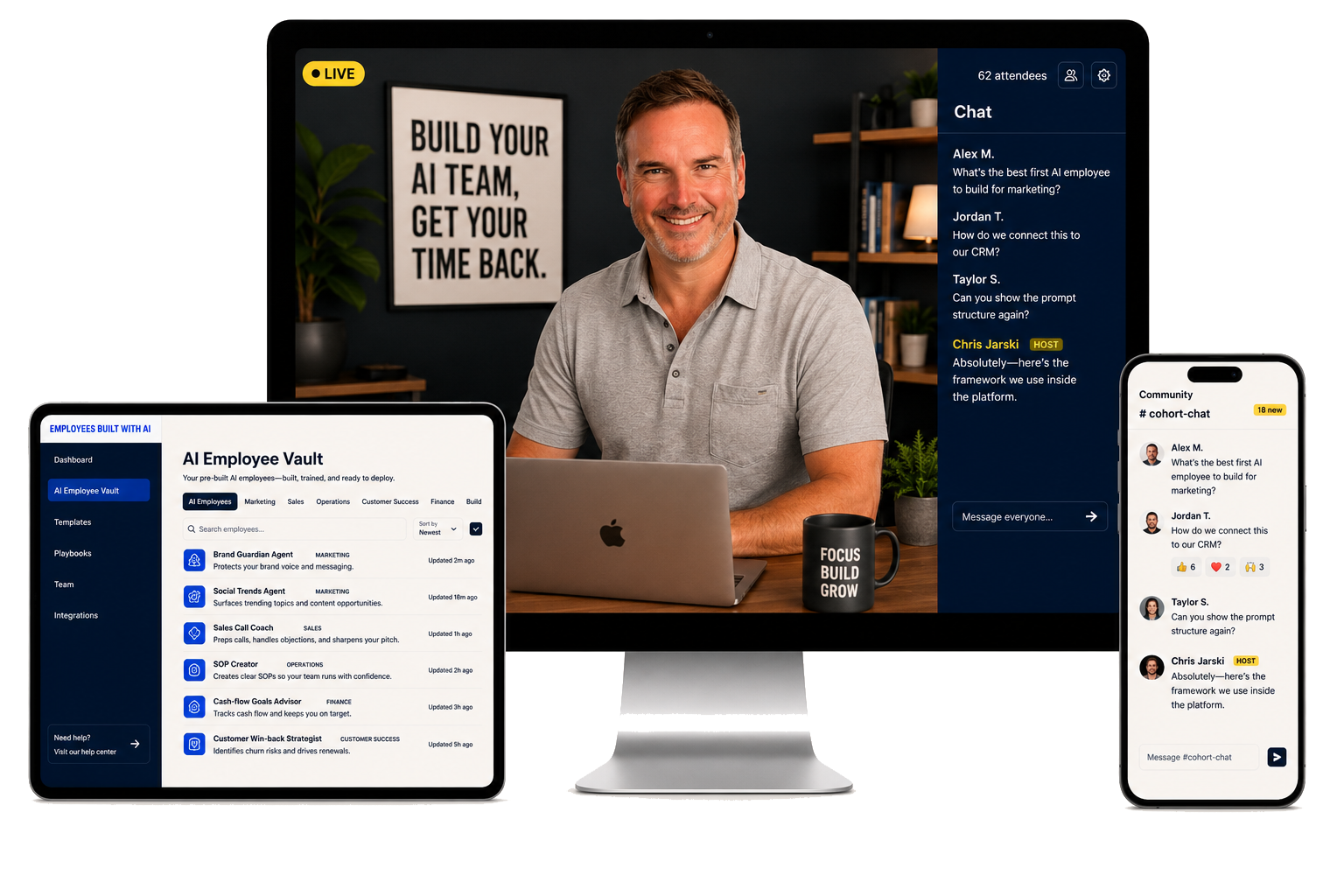
Live build sessions with me every week. A vault of AI employees you build and keep, sorted by department. And a private community of operators figuring it out alongside you. One place. You log in and build.
Run the math.
It's not close.
Here's the part I can speak to as a CPA and former CFO. One investment, three returns, and none of them stop when the cohort does.
$75K–$150K+
- The hire you don't make ($84K loaded)
- Agency and freelancer spend you cancel
- 10 to 20 hours a week back
- Tool sprawl you consolidate
Revenue that compounds
- Follow-up that never drops
- Opportunities you used to miss
- Launches in days, not months
- Margin up, not just top line
A business worth more
- It runs without you in the room
- You own the employees and the Business Brain
- Systems that compound, one by one
- The real moat is you knowing what you know
The return isn't one number. It's three. You save what you were about to spend. You make what you couldn't reach when every hour went to execution. And you build something that's worth more with or without you in it. I built a company and sold it, so that last part isn't a theory to me.
And this isn't about cutting people. It's about giving the people you have a few AI employees each, so every one of them is a builder.
A small-group session every week to block off the time and build, with more hands-on support from us. A room, a schedule, and us in it.
About $100 a week to bring another builder on your team into the cohort, so they build the AI employee coworkers they need. If you've added the Lab, they join it too at no extra cost.
The whole point is to not be the only builder in your business.
Still wondering.
The questions I get asked the most, answered straight.
How much time does this take?+
What tools do I need?+
What if I can't make the live builds?+
Can I bring my team?+
Why learn this from you?+
Build the team.
Keep the company.
Here's the honest version: you can keep doing the repetitive work yourself, or you can spend a few weeks building the AI employees that do it and get your time back. Same business. Very different week. Happy to answer anything before you decide.